
Artist, Performer, Producer: Why the Confusion Breaks Trust
Estimated read time: 4 minutes
Artist, Performer, Producer: the confusion that breaks the conversation
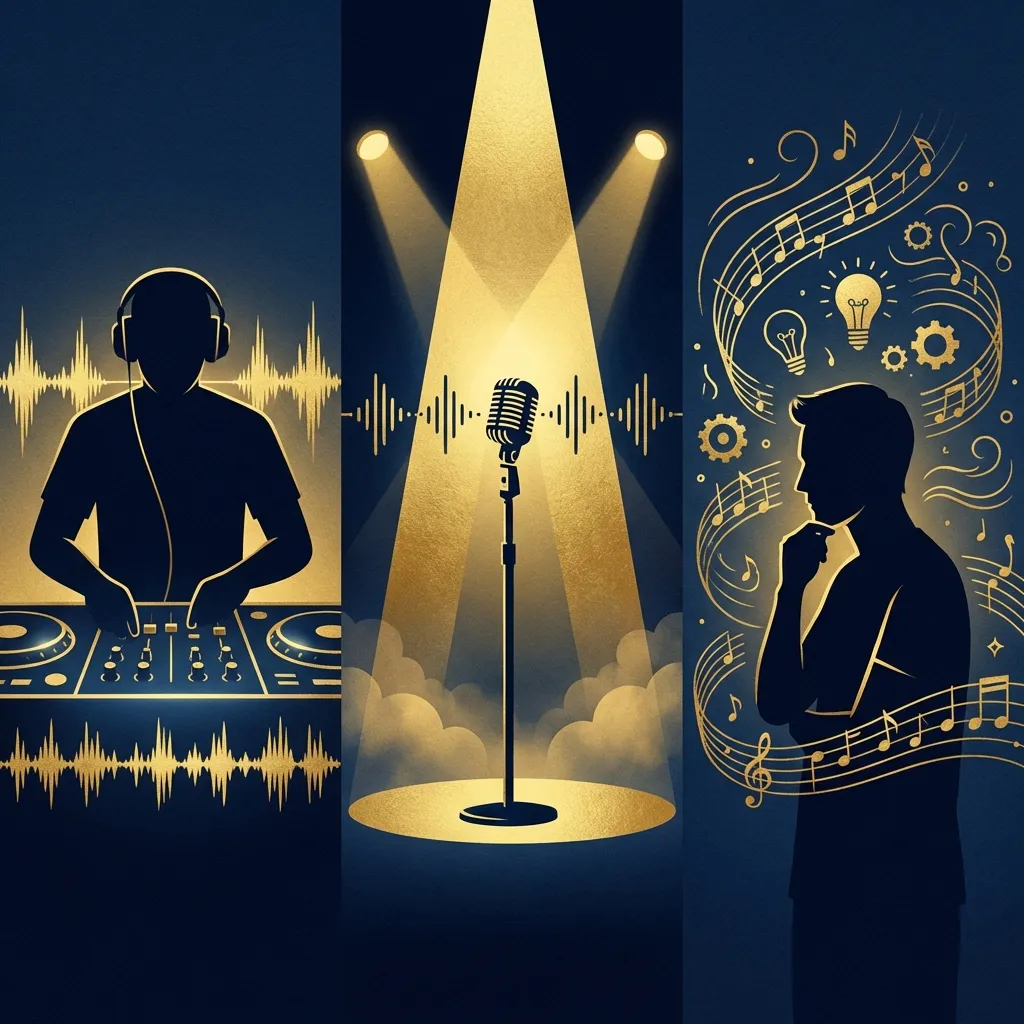
When someone says “I’m an artist,” what do you picture? For most people, it’s the face on stage. The singer. The instrumentalist. The person in the spotlight. This assumption is so strong that when someone creates music without performing it, the first reaction is often skepticism. “If you’re not on stage, are you really the artist?” This confusion collapses three distinct roles into one visible identity—and it breaks conversations before they start.
Three roles, three responsibilities
Artist: The person responsible for the vision and meaning. The artist decides what the work is about, what it should feel like, and whether it succeeds or fails. They carry the accountability.
Performer: The person who embodies the work. Performers interpret, deliver presence, and connect with live audiences. They bring the work into physical or visual space.
Producer: The person who makes structural and directional decisions. Producers shape arrangements, approve edits, control the final sound, and ensure consistency. They direct the outcome.
These roles overlap constantly. Many people hold all three. But they are not the same responsibility.
Why people mix these roles up
Visibility bias. The person you see gets the credit. This is natural. Humans trust faces. We equate the singer with the author because that’s who we witness delivering the emotion. But visibility and authorship are not synonyms.
Modern production reality. Many successful works are led by producers who never appear on camera. Entire catalogs exist where the producer is the creative force, not the vocalist. This isn’t new. It’s standard industry structure.
Online discourse compresses nuance. Social media reduces complex creative workflows into binary labels. “Real artist” vs. “fake artist.” This framing ignores how professional music production actually works.
The confusion isn’t malicious. It’s structural. We’ve been conditioned to expect the face to match the authorship.
The only test that matters: who decides?
Authorship is accountability. The person who decides is the person responsible. If you approve the final mix, you own it. If you reject a take and demand another one, you’re directing. If you choose the lyrics, structure, and emotional arc—you’re the author, whether or not you sing it.
Example decisions producers make:
- Arrangement: Which instruments play when. Which sections repeat. Where the vocals sit in the mix.
- Approval: Whether a track is finished or needs revision. Whether a lyric works or should be rewritten.
These are not passive roles. They are creative decisions with consequences. The producer carries the outcome.
Serious producer ≠ visible performer
You can be a serious creator without stage performance. Delivery, consistency, and ownership clarity matter more than visibility.
What defines serious work:
- Repeatable quality across multiple releases
- Clear credits and transparent roles
- Ownership of rights and responsibilities
- Respect for collaborators (vocalists, engineers, session contributors)
- Consistent public messaging that doesn’t overpromise or misrepresent
Many creators operate entirely behind the scenes. They direct artists. They build catalogs. They run independent labels. None of this requires performing live. None of it is less legitimate.
A note on tools (brief, not a debate)
Tools do not remove authorship. A producer who uses AI vocal generation is making the same structural decisions as one who hires a session vocalist. The responsibility stays human. The direction is human. The approval is human. Tools scale execution; they don’t replace creative accountability.
A simple credibility checklist (for any project)
Use this to evaluate any music project—yours or someone else’s:
- Vision clarity: Can they explain what the work is about in three sentences?
- Repeatable quality: Do they deliver consistent results over time?
- Transparent credits: Are roles and tools clearly disclosed?
- Ownership and rights clarity: Do they control their masters and compositions?
- Respect for collaborators: Are contributors acknowledged and credited?
- Consistent public messaging: Does their story stay coherent across platforms?
If a project meets these standards, the question of stage presence becomes irrelevant.
Closing: words matter because they shape trust
Collapsing “artist,” “performer,” and “producer” into one identity creates false expectations. It leads to confusion, skepticism, and unproductive debates about legitimacy. Clarity starts with language. When we define roles accurately, we can evaluate work fairly.
The producer who never performs live but delivers consistent quality, owns their rights, and respects their collaborators is doing serious work. Responsibility matters more than visibility. Decisions prove authorship. Everything else is presentation.
This article reflects the operational philosophy behind Khmer Style. We are producers and songwriters who use AI-assisted production to create bilingual pop music. We don’t perform live. We own our work. We’re transparent about our process. That’s the standard we hold ourselves to.
Rights & Ownership Snapshot
100% Owned by Khmer Style (Richard Vy)
100% Owned by Khmer Style (Richard Vy)
Registered with SACEM (France)
Voices & arrangement generated via Suno/UDIO. Lyrics & melody owner-directed.